
The Path to Smart Home Adoption (+webinar)


Solutions-Based Research from the Association for Smarter Homes & Buildings (ASHB) reveals the conditions that make people more willing to embrace connected technologies.
Instead of asking “How do we overcome resistance to technology adoption in the home?” ASHB finds where comfort already exists, and how we build outward from there
Overall smart home adoption reached 59% in 2025, up from 49% in 2024
Adoption doesn’t start with safety or monitoring, it starts with where technology feels normal, useful, and under their control.
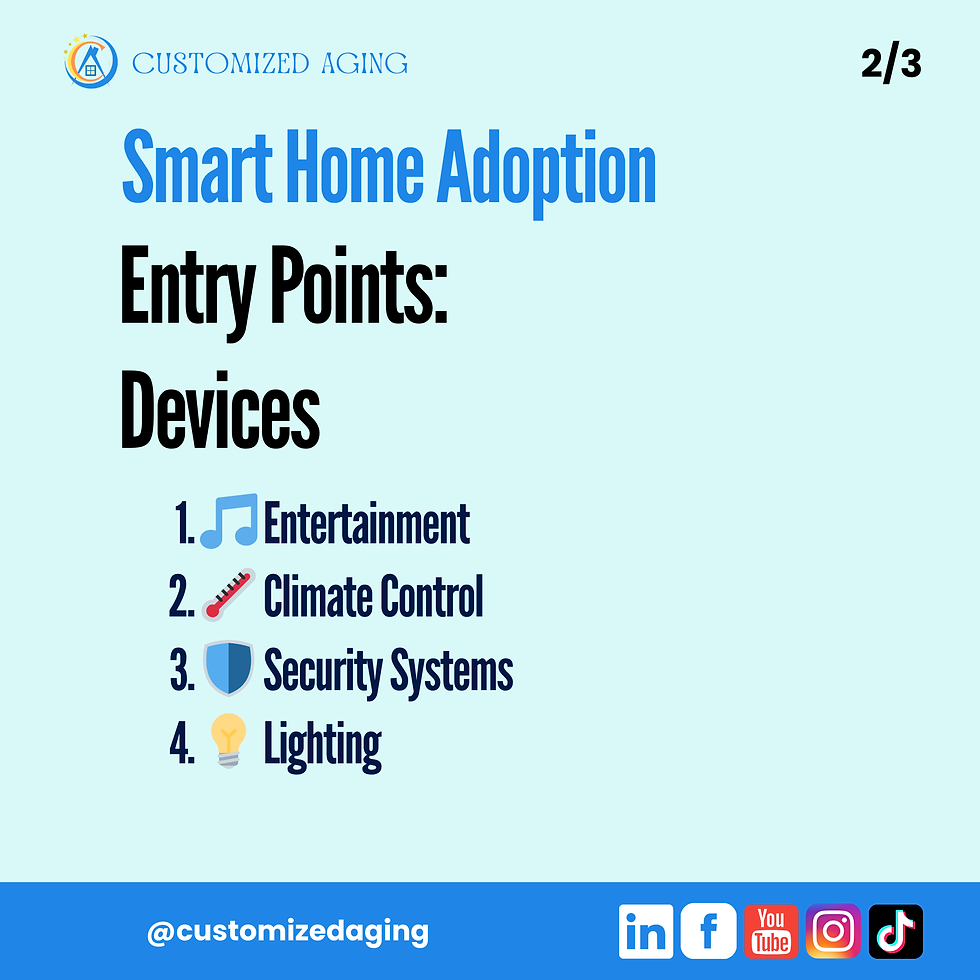
The top entry points:
Entertainment
Climate Control
Security Systems
Lighting
What actually expands willingness?
Transparency & Control When people understand how data is used and retained, 53.8% show increased willingness to adopt AI.
Personalization When users can personalize workflows and consent settings, 53.2% report greater adoption interest.
Trusted Gateways
Everyday value
Adoption increases when technology addresses real, ongoing needs—like energy costs, comfort, and ease of living—not just hypothetical future risk.
Cost and complexity remain barriers:
48.8% cite cost
27.9% cite setup challenges
26.2% cite data privacy concerns (rising to 43.5% for AI)

Adapted from:
ASHB 2025 Smart Home Trends & Technology Adoption Landmark Research Report Executive Summary https://www.ashb.com/wp-content/uploads/2025/10/Survey-Executive-Summary-3.pdf
Take the Conversation Further Register for the Free webinar July 14

The National Aging in Place Council (NAIPC) & the Association for Smarter Homes & Buildings (ASHB) present:
“Rethinking Aging in Place: Smart Homes, Wellness & Better Living”

REGISTER https://us02web.zoom.us/webinar/register/1317815397374/WN_gT_ZVL4DRL6Kbg86aLdHQg#/registration
Join the National Aging In Place Council (NAIPC) and the Association for Smarter Homes & Buildings (ASHB) for a conversation about the intersection of technology & aging in place, and the collaborations needed to make homes more flexible, adaptable, and human-centered.
Aging in place is evolving beyond traditional safety and care solutions. Today’s smart home technologies are creating new opportunities to support wellness, independence, comfort, and quality of life throughout the aging journey.
Industry experts will explore how connected technologies, thoughtful home design, and cross-industry collaboration can help older adults remain in their homes longer while enhancing their overall well-being.
The discussion will address the opportunities and challenges shaping adoption, including consumer trust, technology integration, home modification incentives, and the gap between innovation and real-world implementation. Attendees will gain practical insights into how smart homes can support older adults, caregivers, and families while helping to create more proactive and person-centered aging experiences.
WITH:
• Greg Walker, ASHB
• Tara Ballman, NAIPC
• Cambria Jacobs, Collaboration in Aging
• Elizabeth Parks, Parks Associates
• Robert (Bob) Lane, Robert H. Lane & Associates
• Jeffrey Gray, AgeTech Connect REGISTER https://us02web.zoom.us/webinar/register/1317815397374/WN_gT_ZVL4DRL6Kbg86aLdHQg#/registration
More aging in place reflections and resources at Customized Aging.


Comments